GEOTECHNICAL ENGINEERING1
LUTON
HomeSlopes & WallsActive/passive anchor design

Active and Passive Anchor Design in Luton: Securing Excavations in the Chilterns

Rigorous testing. Clear reporting.

LEARN MORE

A basement excavation on Crawley Green Road hit a band of West Melbury Marly Chalk at just four metres depth—right where the temporary works designer had assumed competent Grade II chalk. The sheet pile wall started to deflect, and the contractor needed a remedial anchor solution within 48 hours. That scenario plays out more often than developers expect across Luton, where the transition from the chalk escarpment to the clay-with-flints plateau creates steep changes in ground stiffness over very short distances. An active anchor transfers load immediately through pre-stress, while a passive anchor mobilises resistance only as the ground deforms; choosing the wrong type—or miscalculating the bond length in weathered chalk—can mean the difference between a stable excavation and a costly collapse. Our team brings that distinction into every design package, combining borehole data with BS 8081 and Eurocode 7 to size anchors that work with the ground, not against it. For sites where the chalk is too fractured, we often recommend a prior grouting campaign to improve the bond zone before anchor installation.

Anchor design in Luton chalk is less about tendon strength and more about bond stress at the grout-ground interface—get that wrong, and failure is progressive and fast.
Our service areas

Process and scope

Luton sits at roughly 160 metres above sea level on the northern edge of the Chiltern Hills, and its population of over 210,000 generates constant demand for multi-storey developments, road widening, and utility shafts—all requiring vertical or near-vertical cuts through variable chalk and overlying clay. An active anchor system applies a design lock-off load, typically 60 to 80 percent of the ultimate tendon capacity, which keeps wall deflections small from day one; that matters in urban Luton where an adjacent building foundation might be less than two metres from the excavation line. Passive anchors, by contrast, develop their resistance progressively and are better suited to permanent works where some initial movement is acceptable. The critical design parameter in both cases is the grout-to-ground bond stress, which can swing from 300 kPa in structureless chalk to over 800 kPa in medium-density chalk when post-grouting is applied. Luton’s winter saturation cycles further reduce effective stress in the upper two metres, so anchor heads must be recessed and protected against frost action and water ingress—a detail too often overlooked in generic designs.
Active and Passive Anchor Design in Luton: Securing Excavations in the Chilterns
Technical reference — Luton

Local considerations

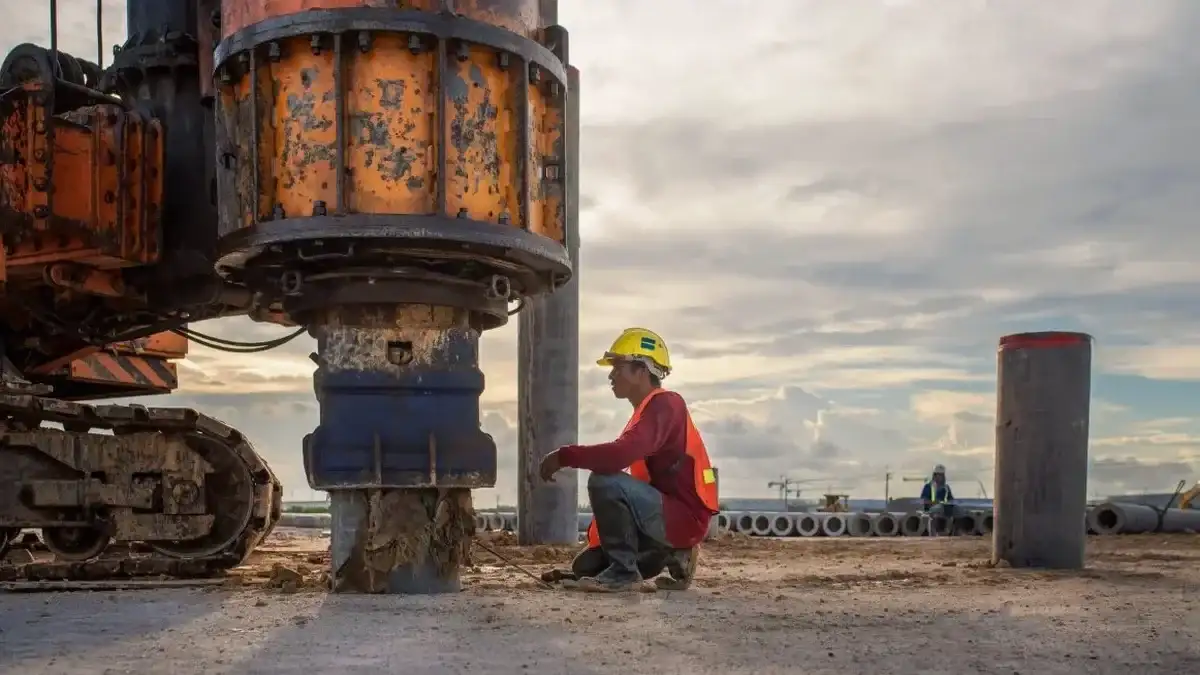
A hollow-stem auger rig with a duplex drilling system is the standard kit for installing anchors through Luton’s chalk and overlying stiff clay, because the drill casing must prevent borehole collapse in the softened upper chalk zone while simultaneously advancing the hole to depths of 15 to 25 metres. The biggest technical risk is grout loss into solution features—small cavities and fissures that riddle the chalk and can swallow several cubic metres of neat cement grout before any bond pressure builds. If the grout escapes into a void, the anchor never achieves the design bond length, and the proof test will fail at a fraction of the lock-off load. A secondary risk is tendon relaxation in active anchors: Luton’s seasonal temperature swings from -5 °C to 30 °C induce thermal elongation and contraction cycles in the steel strand, which over months can reduce the residual pre-stress by 10 to 15 percent unless the anchor head incorporates a re-stressable wedge system with load-monitoring capability.

Need a geotechnical assessment?

Reply within 24h.

Email: contact@geotechnical-engineering1.com

Video resource

Relevant standards

BS 8081:2015 + A2:2018 – Code of practice for grouted anchors, BS EN 1997-1:2004 + UK National Annex – Eurocode 7: Geotechnical design, BS EN 1537:2013 – Execution of special geotechnical work: ground anchors, BS 5930:2015 + A1:2020 – Code of practice for ground investigations

Technical data

ParameterTypical value
Bond length in competent chalk3–8 m depending on load class
Corrosion protection classCategory 2 (permanent) per BS 8081
Typical active anchor lock-off load60–80% of ultimate tendon capacity
Grout compressive strength at 28 days≥ 30 N/mm² (cube test)
Allowable tendon stress0.6 × fpu for strand tendons
Minimum anchor inclination from horizontal10°–15° for gravity grouting
Free length verificationHydraulic jack lift-off test on 100% of anchors

Frequently asked questions

What distinguishes an active anchor from a passive anchor in practice?

An active anchor is pre-stressed to a specified lock-off load immediately after installation, which means it actively restrains the structure from the moment the jack is removed. A passive anchor is not pre-stressed at installation; it only develops resistance as the retained structure moves and the tendon elongates. Active anchors are typical for temporary excavations where movement must be minimised, while passive anchors are more common in permanent works where some small displacement is tolerable and long-term relaxation is less of a concern.

How does the chalk geology in Luton affect anchor design?

The chalk beneath Luton varies from weak, weathered Grade IV material to moderately strong Grade II chalk, and this variability directly affects the grout-to-ground bond stress. In lower-grade chalk, bond lengths must be increased or post-grouting applied to achieve the required capacity. Solution features such as dissolution pipes and fissures are common and can cause grout loss during installation; we routinely specify duplex drilling with casing through the upper weathered zone and grout-loss detection during primary injection to avoid unbonded lengths.

What does anchor design and testing cost for a typical Luton project?

For a standard anchor design package covering 10 to 30 anchors—including geotechnical interpretation, bond length calculations, corrosion protection specification, and on-site suitability testing—project costs in Luton typically range from £850 to £3,070 depending on the number of anchors, depth, and testing requirements. Permanent anchors with double corrosion protection and 120-year design life are at the upper end of that range.

What testing is required for ground anchors under UK standards?

BS 8081 and BS EN 1537 require a three-stage testing regime. Suitability tests are performed on sacrificial anchors before production drilling to confirm the design bond stress. Acceptance tests are carried out on every production anchor to verify it meets the proof load. Finally, lift-off tests or load cell monitoring may be specified for critical permanent anchors to confirm residual load over time. In Luton, where chalk conditions vary, we typically recommend suitability testing on at least three anchors in different ground profiles.

Location and service area

We serve projects in Luton and surrounding areas.

View larger map