GEOTECHNICAL ENGINEERING1
LUTON
HomeSeismicSoil liquefaction analysis

Soil Liquefaction Analysis in Luton

Rigorous testing. Clear reporting.

LEARN MORE

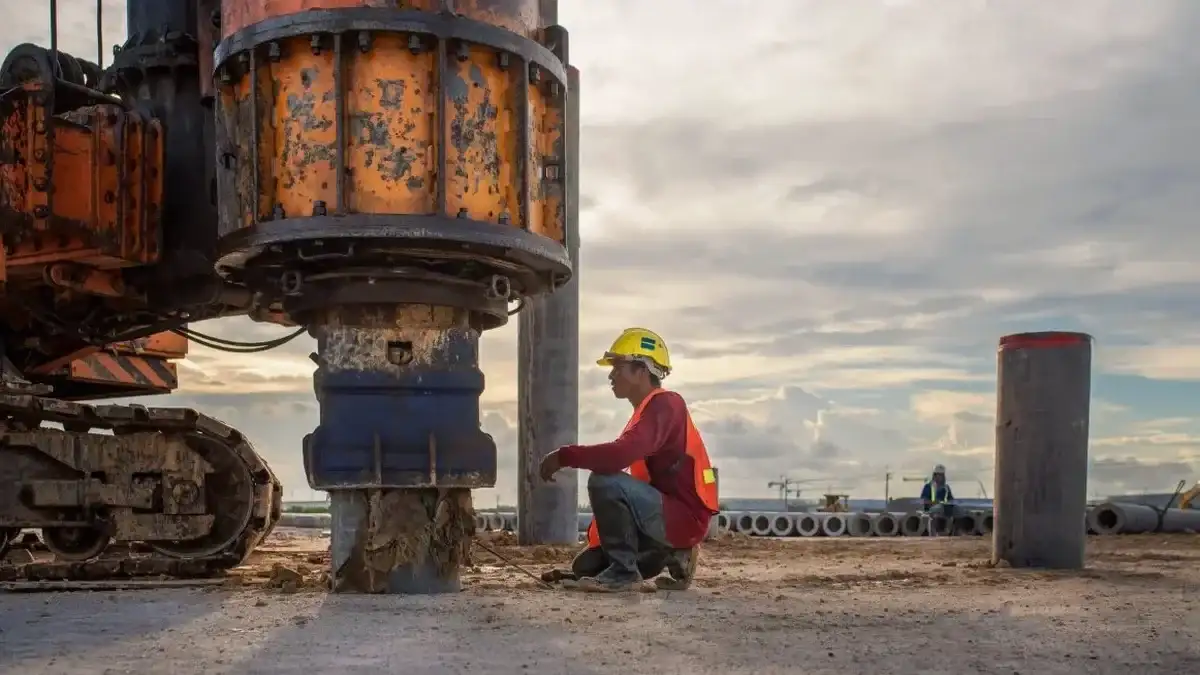
The cone penetration test rig is the primary tool our engineers mobilise to Luton. A 20-tonne CPT truck pushes an instrumented cone into the ground at a constant 2 cm/s, recording tip resistance, sleeve friction, and pore pressure every centimetre. This continuous profile is what you need for a solid soil liquefaction analysis. CPT testing gives us the raw data to calculate the factor of safety against liquefaction, without the sample disturbance issues that plague borehole SPT data. The silty sands and river terrace gravels along the River Lea corridor demand this direct-push approach. We process the data through the Boulanger & Idriss (2014) triggering procedures, the current standard embedded in BS EN 1998-5 for seismic geotechnics.

A saturated loose sand with less than 15% fines and a Vs30 below 200 m/s is a liquefiable deposit until proven otherwise.
Our service areas

Process and scope

The chalk bedrock in Luton is shallow across much of town, but the fluvial deposits sitting on top are what worry us. We have seen 3 to 6 metres of loose to medium-dense sandy silt in the Bury Park and High Town areas, right where the groundwater table sits less than 2 metres below ground. That combination of loose saturated granular soil and shallow water is the textbook setup for cyclic liquefaction. The BS 5930 investigation framework requires us to map these layers precisely. We do this by pairing the CPT with grain size analysis on disturbed samples from sonic cores to confirm the fines content, which directly shifts the cyclic resistance ratio. The MASW survey then gives us the shear wave velocity profile, a second independent metric for estimating the soil's resistance to earthquake-induced pore pressure rise.
Soil Liquefaction Analysis in Luton
Technical reference — Luton

Local considerations

BS EN 1998-5:2004, Section 4, Annex B, specifically addresses liquefaction potential assessment. For a site in Luton, this is not just a regulatory checkbox. The town sits in an area of very low regional seismicity, but the hazard is not zero. The 2008 Market Rasen earthquake, a magnitude 5.2 event felt across Bedfordshire, is a reminder that intraplate earthquakes can and do occur. A structure on a liquefiable lens that densifies and settles 50 mm differentially during even a moderate shake can rack a steel frame or shear buried utilities. The risk is financial and operational disruption, not dramatic collapse. Our analysis provides a clear LPI (Liquefaction Potential Index) map for your site, so the structural engineer can decide whether ground improvement via vibrocompaction or a deep foundation scheme is the rational path forward.

Need a geotechnical assessment?

Reply within 24h.

Email: contact@geotechnical-engineering1.com

Relevant standards

BS EN 1998-5:2004 (Eurocode 8: Design of structures for earthquake resistance, Part 5: Foundations, retaining structures and geotechnical aspects), BS 5930:2015+A1:2020 (Code of practice for ground investigations), BS EN ISO 22476-1:2012 (Geotechnical investigation and testing — Field testing — Part 1: Electrical cone and piezocone penetration test)

Technical data

ParameterTypical value
Analysis standardBoulanger & Idriss (2014) per BS EN 1998-5
Primary field testSeismic CPTu (cone penetration with pore pressure)
Key input parametersqc, fs, u2, Vs, fines content (FC %)
Output metricsFactor of safety (FSL), LPI, LSN, post-liquefaction settlement
Groundwater conditionMeasured during CPT dissipation tests
Cyclic resistance ratio (CRR)Corrected for overburden stress (Kσ) and static shear (Kα)

Frequently asked questions

What is the typical cost range for a soil liquefaction analysis on a residential plot in Luton?

For a single residential plot in Luton requiring two CPT soundings, lab index testing, and a full liquefaction triggering report, the fee typically falls between £2.000 and £3.100 plus VAT. The final figure depends on access constraints and the depth of refusal.

How deep do you need to test for a liquefaction assessment?

We test to the maximum depth of the saturated granular layer, or 20 metres below ground, whichever is shallower. In Luton, the chalk bedrock often limits the investigation depth to between 5 and 10 metres, which captures the full thickness of the fluvial deposits.

What is the difference between LPI and LSN in your reports?

LPI (Liquefaction Potential Index) integrates the factor of safety and thickness of all liquefiable layers above 20 metres depth, giving a site-wide severity rating. LSN (Liquefaction Severity Number) is a New Zealand-derived index that correlates better with observed land damage and is useful for shallow deposits. We report both to give a complete picture.

Location and service area

We serve projects in Luton and surrounding areas.

View larger map