GEOTECHNICAL ENGINEERING1
LUTON
HomeLaboratoryTriaxial test

Triaxial Testing in Luton: Shear Strength & Settlement Analysis

Rigorous testing. Clear reporting.

LEARN MORE

Luton sits on the Cretaceous chalk of the Chiltern Hills, with an average elevation of 110 metres above sea level. The geology here is deceptive — weathered chalk overlain by pockets of clay-with-flints, Head deposits, and alluvium along the River Lea. For any project involving deep retaining structures or heavily loaded foundations, predicting how these variable soils will behave under load is where a triaxial test becomes indispensable. Unlike simpler index tests, it replicates the actual stress conditions the ground will experience. We typically recommend following up the site investigation with seismic refraction to map bedrock depth, and coordinating results with our grain size analysis to understand the fines content affecting drainage.

The triaxial test remains the most reliable method for obtaining the effective shear strength parameters needed for numerical modelling in Luton's chalk geology.
Our service areas

Process and scope

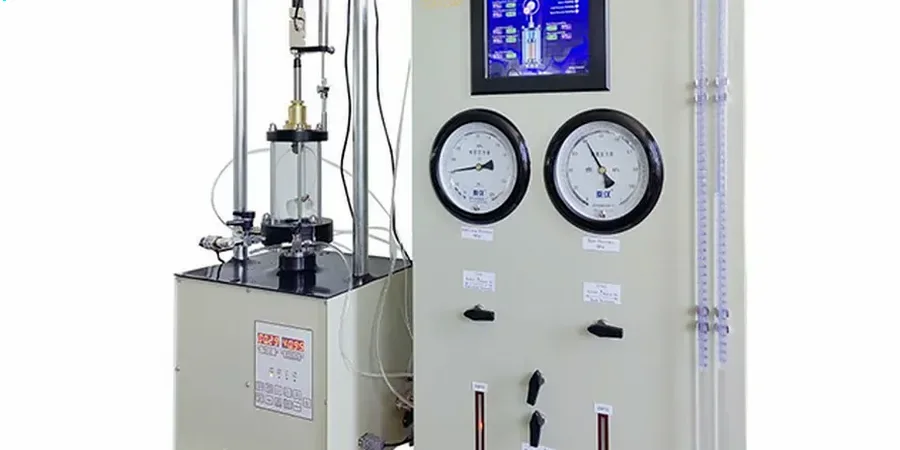
Luton’s expansion from a hat-making town to a logistics hub with the airport and the M1 corridor has pushed development into challenging ground. The chalk here is not uniform — zones of dissolution features and solution pipes can create weak spots that property developers overlook. Our laboratory runs advanced triaxial tests, including Consolidated Undrained (CU) and Consolidated Drained (CD) procedures, on undisturbed samples from across the region. For the stiff, overconsolidated clays found in the northern parts of town, we often pair the shearing phase with an in-situ permeability assessment to characterise pore pressure build-up. When the triaxial results indicate sensitive, low-strength soils, we provide parameters to evaluate whether a slope stability analysis is warranted for the development’s earthworks. The equipment applies back pressures to fully saturate specimens, with pore water pressure measurement via transducers, giving you the effective stress envelope — not just total stress figures.
Triaxial Testing in Luton: Shear Strength & Settlement Analysis
Technical reference — Luton

Local considerations

Here's a practical observation: in Luton, we often see engineers relying on SPT N-values and presumptive bearing capacities for chalk when the material is actually structure-controlled, not density-controlled. A triaxial test on core samples reveals whether the chalk is putty-grade or blocky-grade, which changes your settlement prediction by an order of magnitude. The real risk isn't catastrophic collapse — it's serviceability failure. Differential settlement across a warehouse floor slab, or excessive movement in a bridge abutment on the Luton-Dunstable busway, stems from treating chalk as a generic rock. Without a drained triaxial test, you're missing the stiffness degradation curve under long-term loading. And if you're dealing with the Head deposits near the airport, an undrained test is non-negotiable to capture the clay's low shear strength.

Need a geotechnical assessment?

Reply within 24h.

Email: contact@geotechnical-engineering1.com

Relevant standards

BS 1377-8:1990 — Soils for civil engineering purposes. Shear strength tests (effective stress), BS EN ISO 17892-8:2018 — Geotechnical investigation and testing. Laboratory testing of soil. Unconsolidated undrained triaxial test, BS EN ISO 17892-9:2018 — Consolidated triaxial compression tests on water saturated soils, BS 5930:2015+A1:2020 — Code of practice for ground investigations

Technical data

ParameterTypical value
Cell pressure rangeUp to 1,700 kPa
Specimen diameter38 mm / 50 mm / 70 mm / 100 mm
Drainage conditionsCU, CD, UU
Loading rate0.001 – 5 mm/min
Saturation methodBack pressure / CO2 flushing
Parameter outputc', φ', E, σ1-σ3 vs ε
Relevant standardsBS 1377-8, EN ISO 17892-8/9

Frequently asked questions

What's the typical cost range for a triaxial test on a Luton site?

For a standard triaxial test suite (one specimen, CU or CD conditions), expect to budget between £1,590 and £2,090. The final figure depends on the number of effective stress points required — a full Mohr-Coulomb envelope with three specimens will be at the higher end. We provide a detailed quote once we review the borehole logs and project loading requirements.

How long does a triaxial test take in the lab?

A CU test with pore pressure measurement typically runs 1 to 2 weeks from sample receipt. A full CD test takes longer — 3 to 5 weeks — because the shearing stage must proceed slowly enough to prevent pore pressure accumulation. Saturation and consolidation phases are the rate-limiting steps, not the shearing itself.

Do I need a triaxial test if I already have SPT data from my Luton site?

SPT gives you an index of penetration resistance, not shear strength parameters. If your design requires numerical modelling (FEM) or you're working near property boundaries with tight settlement tolerances, the triaxial test provides the stiffness and strength data that SPT cannot. It is the difference between an empirical guess and a verifiable effective stress analysis.

Location and service area

We serve projects in Luton and surrounding areas.

View larger map