GEOTECHNICAL ENGINEERING1
LUTON
HomeLaboratoryAtterberg limits

Atterberg Limits Testing for Luton’s Clay Formations

Rigorous testing. Clear reporting.

LEARN MORE

The hills around Luton sit on a mantle of clay-with-flints over the Chalk Group, but much of the town centre is underlain by the Gault Formation—a stiff, grey clay that swells when wet and shrinks in dry spells. On a borehole log for a warehouse extension off Dallow Road, we recorded moisture contents above 28% at just 2.5 metres depth, right where the footings were planned. Atterberg limits become the first real conversation with a clay: the liquid limit tells you when it starts to flow, the plastic limit marks where it crumbles, and the gap between them—the plasticity index—defines how much seasonal movement to expect. For Luton’s post-war residential stock and the new logistics sheds spreading toward the M1, that number drives foundation depth decisions. We run every determination inside a UKAS-accredited laboratory under BS EN ISO 17892-12:2018, and we pair the index values with a grain-size analysis when the fines fraction needs quantifying for earthworks specification.

A plasticity index above 25% in Luton’s Gault Clay means a foundation designed for moisture equilibrium, not just bearing capacity.

Our service areas

Process and scope

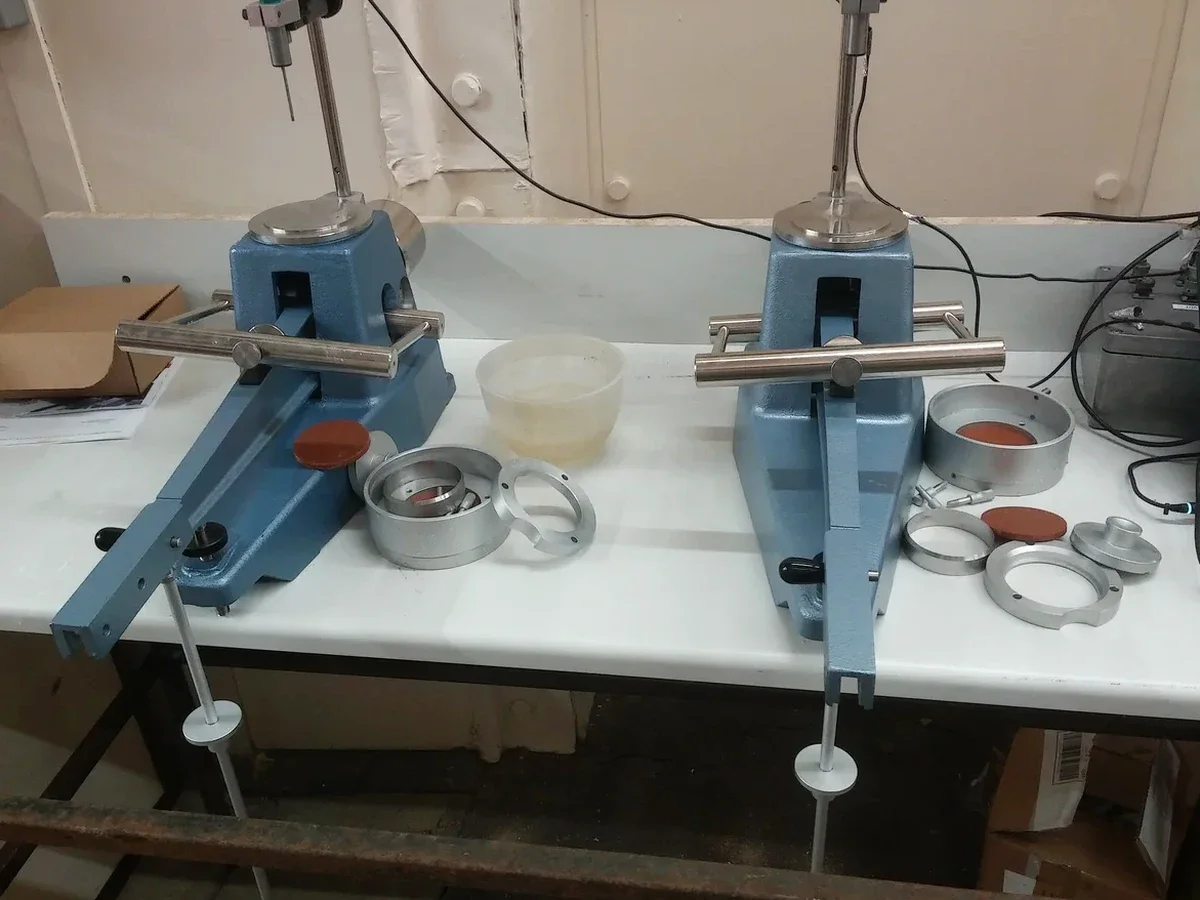
Luton’s expansion from a hat-making town into a logistics hub left a patchwork of made ground, particularly along the River Lea corridor and the old railway cuttings near Leagrave. The 1960s housing boom placed hundreds of semi-detached homes on strip footings at 600-900 mm depth—often into desiccated Gault Clay with a plasticity index exceeding 30%. Those are the sites that now crack at the first prolonged dry summer. Our testing programme follows BS 5930:2015+A1:2020 for sample preparation and uses the Casagrande cup method for the liquid limit, supplemented by the fall-cone technique when the contract calls for it. We report the liquidity index alongside the Atterberg limits because a clay at its natural water content behaves very differently from the same clay remoulded. For schemes near the Chiltern dip-slope where chalk marl mixes with clay drift, we routinely sample at 500 mm vertical intervals to catch thin seams that a single bulk bag would miss. The lab turnaround is 48 hours from receipt, with rush options when the piling rig is already mobilised.
Atterberg Limits Testing for Luton’s Clay Formations
Technical reference — Luton

Local considerations

A four-storey apartment block on Crawley Green Road started showing 3 mm cracks in the stairwell six months after handover. The original ground investigation skipped plasticity testing on the assumption that the chalk bedrock would control behaviour. What the boreholes actually hit was 4.2 metres of Gault Clay with a plasticity index of 38%—highly reactive and fully softened at the weathered surface. Under BS EN 1997-1:2004 (Eurocode 7), designing in such conditions without index properties means the characteristic undrained shear strength cannot be reliably selected from SPT N-values alone. The remedial scheme involved underpinning the eastern wing at a cost that dwarfed the price of a full Atterberg suite. On sloping sites toward Stopsley, we also see clay creep where the liquidity index sits above 0.8; the material behaves more like a viscous fluid than a plastic solid, and retaining structures need to account for long-term lateral pressures that simple Rankine calculations miss. Our reports flag these thresholds explicitly so the structural engineer knows the ground isn’t just “firm clay” on a log—it’s a material with a defined stress history and a predictable shrink-swell envelope.

Need a geotechnical assessment?

Reply within 24h.

Email: contact@geotechnical-engineering1.com

Relevant standards

BS 5930:2015+A1:2020 - Code of practice for ground investigations, BS EN ISO 17892-12:2018 - Determination of liquid and plastic limits, BS EN 1997-1:2004 (Eurocode 7) - Geotechnical design

Technical data

ParameterTypical value
Liquid limit (LL)Determined by Casagrande cup (BS EN ISO 17892-12)
Plastic limit (PL)Thread-rolling method, 3 mm crumbling criterion
Plasticity index (PI = LL - PL)Numerical difference; classifies clay reactivity
Liquidity index (LI)(Natural w - PL) / PI; indicates in-situ consistency
Sample preparationWet sieved at 425 µm; oven-dried at 60°C for organic clays
Reporting standardBS 5930:2015+A1:2020, BS EN ISO 17892-12:2018
Typical Gault Clay PI range28-42% (high plasticity), dependent on carbonate content

Frequently asked questions

Why are Atterberg limits relevant for a standard house foundation in Luton?

Much of Luton sits on Gault Clay with plasticity indices routinely between 28% and 42%. That classifies it as a high-plasticity clay with significant shrink-swell potential. Building Regulations Approved Document A and NHBC Standards Chapter 4.2 require the plasticity index to be known so the foundation depth can be set below the zone of seasonal moisture variation—typically 900 mm to 1.2 m in this area, sometimes deeper near trees.

Can you test samples from our own trial pits, or do we need a full ground investigation?

We accept undisturbed and bag samples from contractor-dug trial pits provided they are sealed immediately to preserve natural moisture content. We supply sample jars and labelling protocols in advance. The lab follows BS EN ISO 17892-12:2018 regardless of who collected the material, and we note the sampling method on the report so the engineer can assess sample quality.

What does Atterberg limits testing cost in Luton?

For a standard Atterberg suite covering liquid limit, plastic limit, and natural moisture content on a single sample, the fee ranges from £50 to £80 depending on the number of specimens and whether the fall-cone method is required in addition to the Casagrande cup. Volume pricing applies for multi-sample programmes.

How do I use the plasticity index to estimate undrained shear strength?

The plasticity index correlates with the ratio of undrained shear strength to preconsolidation pressure (cu/σ’p) via the SHANSEP framework, originally proposed by Ladd and Foott. For normally consolidated Gault Clay with a PI around 35%, cu/σ’v0 typically falls between 0.22 and 0.28. We report the liquidity index alongside the Atterberg limits so your designer can select an appropriate strength profile for EC7 Design Approach 1 calculations.

Location and service area

We serve projects in Luton and surrounding areas.

View larger map