GEOTECHNICAL ENGINEERING1
LUTON
HomeSeismicBase isolation seismic design

Base Isolation Seismic Design for Luton’s Variable Ground Conditions

Rigorous testing. Clear reporting.

LEARN MORE

A common misstep we observe across Luton is the assumption that the UK's low seismicity negates the need for any advanced seismic consideration, only to find later that the stiff chalk and softer alluvial deposits in the Lea Valley create a problematic resonance contrast. The team here has repeatedly encountered foundations where differential settlement under a mild seismic event, amplified by this subsoil duality, would have compromised a standard fixed-base design. Integrating a seismic microzonation study early in the project is what allows us to calibrate an isolation system precisely for Luton’s specific spectral response, rather than relying on a generic UK-wide map. This approach, refined through years of geotechnical investigation across Bedfordshire, shifts the project from a code-minimum compliance exercise to a genuinely risk-informed design.

Calibrating an isolation system to Luton’s weathered chalk-to-alluvium transition, rather than a generic UK spectrum, is what prevents a low-seismicity design from becoming a resonance liability.
Our service areas

Process and scope

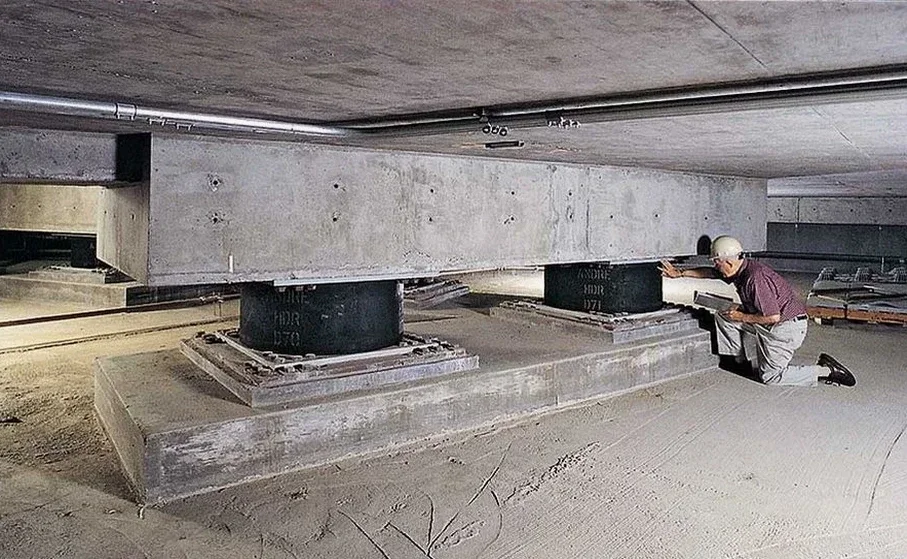
A practical observation from our Luton project files is that the Chalk Group bedrock, while competent at depth, often presents a weathered and highly fractured upper horizon where the effective shear wave velocity can drop below 200 m/s — a stark contrast to the 400+ m/s values assumed in preliminary desk studies. This discrepancy critically alters the site classification under BS EN 1998-1:2004 and the resulting design spectrum. Our isolation system design therefore begins with a site-specific assessment using in-situ seismic refraction to map the transition from the Head deposits down through the Lower Chalk, ensuring the isolator parameters (effective period, damping ratio, displacement capacity) are tuned not to a textbook profile but to Luton’s actual ground. We model the isolation interface using non-linear time-history analysis, factoring in the near-source effects from the modest but real seismogenic zones in the East Midlands, and detailing the moat wall covers and service connections for the predicted maximum displacement.
Base Isolation Seismic Design for Luton’s Variable Ground Conditions
Technical reference — Luton

Local considerations

Under BS EN 1998-1:2004, even UK structures in consequence class CC2 require a ductility check if the design PGA exceeds 0.02g — a threshold that several parts of Luton, particularly on the alluvial soils near the River Lea, can reach under the 475-year return period event. The principal risk is not collapse but non-structural damage and business interruption in critical facilities, such as the airport infrastructure or data centres in the Capability Green business park, where an un-isolated structure would transmit floor accelerations exceeding equipment tolerance. A poorly executed isolation design that ignores the vertical component of ground motion, often prominent in shallow UK events, risks isolator uplift and moat wall impact. Our design methodology specifically verifies the tensile stress in elastomeric bearings and the uplift restraint in sliding isolators against this vertical acceleration, a check frequently omitted in low-seismicity regions.

Need a geotechnical assessment?

Reply within 24h.

Email: contact@geotechnical-engineering1.com

Relevant standards

BS EN 1998-1:2004 + UK National Annex (Design of structures for earthquake resistance), BS EN 15129:2018 (Anti-seismic devices), BS EN 1997-1:2004 + UK NA (Geotechnical design), BS 5930:2015 (Code of practice for ground investigations)

Technical data

ParameterTypical value
Design code for isolatorsBS EN 15129:2018
Seismic action standardBS EN 1998-1:2004 + UK NA
Site classification (typical Luton profile)Class C to B (depending on chalk weathering depth)
Reference Peak Ground Acceleration (PGA)0.02g to 0.04g (Type 2 spectrum)
Isolator types assessedHDRB, LRB, FPS (curved surface sliders)
Maximum displacement capacity modelled±150 mm to ±300 mm
Effective damping ratio range15% to 30%
Geotechnical input for soil-structure interactionSite-specific G0 and degradation curves from in-situ testing

Frequently asked questions

Is base isolation really necessary for a building in Luton given the UK’s low seismicity?

For ordinary residential or low-rise commercial buildings, a well-executed fixed-base design to BS EN 1998-1 is generally adequate. However, for structures housing sensitive equipment, such as the data centres and aviation electronics facilities around London Luton Airport, or for buildings designated as critical infrastructure, base isolation becomes the most reliable method to keep floor accelerations below 0.05g and protect operations during even a moderate event.

How does Luton’s chalk geology affect the isolation system’s performance?

The chalk beneath Luton, particularly the Upper and Middle Chalk formations, is stiff and generally provides a competent base for the isolation interface. The challenge lies in the variable depth of weathering and the overlying low-velocity drift deposits, which can amplify short-period motion. Our analysis explicitly models this impedance contrast to ensure the isolation period is sufficiently long to avoid tuning to the soil’s amplified frequency.

What is the typical cost range for a base isolation seismic design package for a project in Luton?

For a comprehensive design package covering the conceptual design, non-linear time-history analysis, and the production testing specification, the cost typically falls between £3,510 and £5,760, depending on the structural complexity, the number of required ground motion records, and the extent of peer review coordination with the design team.

Which isolator type is most suitable for a steel-framed structure on Luton’s alluvial soils?

On the softer alluvial deposits near the River Lea, we often recommend curved surface sliders (FPS) because their restoring force is proportional to the carried weight, providing a natural period independent of the superstructure mass. For lighter steel frames where uplift is a concern, high-damping rubber bearings with a bolted connection detail might be preferred, provided the vertical acceleration demand is verified.

How do you verify the isolator performance before installation on a Luton site?

The verification protocol follows BS EN 15129:2018 and involves two stages: factory production control tests on every manufactured isolator, where the full-scale dynamic stiffness and damping are measured at the design displacement, and an initial type test on two prototype isolators. On site, we supervise the installation to ensure the lower and upper connecting plates are levelled to within 3 mm, as any inclination can induce parasitic moments and reduce the isolator’s effective damping.

Location and service area

We serve projects in Luton and surrounding areas.

View larger map